

I’m Eddie, and after two decades crawling through ductwork across Paradise Valley, Scottsdale, Phoenix, Chandler, and Gilbert, I can tell you the single most misunderstood thing homeowners believe about dryer vents: that a long run is the main danger. It isn’t. A Kinked Dryer Duct Fix is almost always the more urgent problem — and most homeowners have no idea it’s sitting behind their dryer right now.
Why a Kink Is More Dangerous Than Extra Length
Think of your dryer duct like a garden hose. Stretch it out long and water still flows. Bend it sharply in the middle and you get a trickle. Hot, moist, lint-laden air works the same way. A sharp kink — the kind that happens when a dryer gets pushed too close to the wall — collapses the duct, cuts airflow by 50% or more, and creates a lint trap right at that bend. Lint packs in. Moisture can’t escape. Heat builds. That’s the recipe for a dryer fire, and the U.S. Fire Administration reports that dryers cause roughly 2,900 home fires per year, with failure to clean being the leading factor.
A long duct run — say, 20 to 25 feet of rigid metal — still allows air to move freely. Yes, length adds resistance, and yes, it should stay within manufacturer limits. But a properly installed long run beats a short kinked one every single time. The kink wins the danger contest, and it wins by a lot.
“I’ve seen six-foot flexible ducts crammed behind a dryer that were more clogged than 30-foot rigid runs. It’s never about how far the air has to travel — it’s about whether it can travel at all.”
— Eddie, Pure Air Service
Dryer Duct Material Types — and Which One Kinks
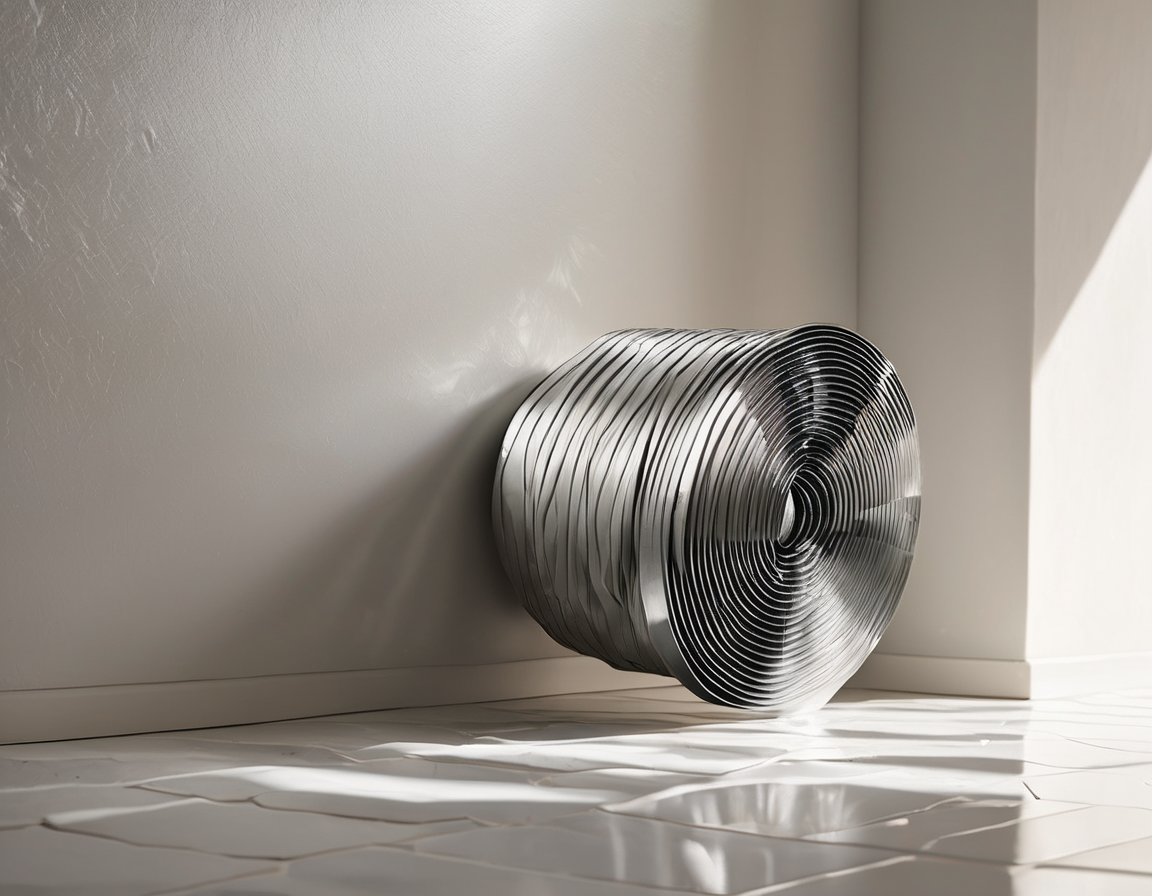
Not all duct materials are created equal. Understanding dryer duct material types tells you exactly where kink risk lives.
| Material | Kink Risk | Lint Buildup | Code Approved |
|---|---|---|---|
| Rigid aluminum (smooth wall) | Low — rigid by design | Minimal | Yes ✓ |
| Semi-rigid aluminum | Medium — bends but holds shape | Low to moderate | Yes ✓ |
| Flexible foil (accordion) | Very High — collapses easily | High — ridges trap lint | Transitional only |
| Plastic/vinyl flexible | Extreme — melts under heat | Extreme | No ✗ |
That flexible foil accordion duct is what we find behind roughly 70% of dryers here in Phoenix, AZ. Installers use it because it’s cheap and easy to connect. Homeowners never think twice about it — until the dryer starts taking two cycles to dry one load. If that sounds familiar, read our breakdown of exactly why that happens — a kinked or clogged flex duct is almost always behind it.
What Happens at the Wall: Termination and Floor Vents

Once you straighten out the duct behind the dryer, air has to get somewhere. How it exits the house matters just as much as how it travels. Dryer vent wall termination cleaning is something most homeowners skip entirely, and in Phoenix, AZ‘s dusty desert environment that wall cap fills with lint, debris, and sometimes even bird nests (I am not joking — I pulled a full nest out of a home near McCormick Ranch in Scottsdale last spring).
A wall cap with a stuck flapper acts like another kink. Air backs up. Lint accumulates at the elbow just inside the wall. Same danger, different location.
Some homes in Phoenix, AZ — especially ranch-style builds in Chandler and Gilbert — run the dryer vent through the floor rather than the wall. Dryer vent through floor cleaning is trickier because the duct travels down, makes at least one 90-degree turn, and exits through a crawl-space or exterior soffit. Those turns are prime kink spots, and they’re invisible. If your home uses this configuration, don’t assume it’s fine just because you can’t see it. Schedule an inspection — especially if the dryer has felt sluggish lately.
The Warning Signs You Shouldn’t Ignore
- Clothes still damp after a full cycle
- Laundry room feels unusually hot or humid while the dryer runs
- Burning smell — even faint — during operation
- Dryer exterior is hot to the touch on top or sides
- It’s been more than a year since anyone checked the duct
- You don’t actually know where the duct exits the house
That last one is more common than you’d think. We’ve been in homes in Paradise Valley and North Scottsdale where the previous owners installed a dryer vent that terminated inside the wall cavity — not outside the house at all. That is a fire and mold situation waiting to happen. If you’re not sure what’s behind your dryer, that’s reason enough to call.
And if clothes are coming out of the dryer with a strange smell even though they smelled fine in the washer, that’s a duct problem too. We wrote a full post explaining why that happens — it almost always points back to restricted airflow or moisture trapped in a kinked or clogged duct.
Kinked Dryer Duct Fix: What the Job Actually Involves
When we show up for a dryer vent job, we don’t just run a brush through the duct and call it done. We pull the dryer out, inspect the full duct run from the back of the machine to the termination point, look for kinks, crushes, disconnected sections, and material type. If there’s flexible foil that’s kinked or damaged, we’ll tell you — honestly — whether it needs replacing. You can also read our guide on when replacement beats cleaning so you know what to expect before we even arrive.
We serve homeowners across Phoenix, AZ and AZ, and we’ve built this business one honest job at a time. No 1-800 number, no franchise script, no different technician every visit. If you want to understand the difference that makes, here’s why family-owned matters when it comes to work done inside your home.
A kinked dryer duct isn’t a “check it someday” problem. It’s a fire hazard that’s also costing you money on every load of laundry. Let us take a look — and fix it right the first time.
Some content on this site is AI-assisted and may not reflect exact current details — please verify with Pure Air Service at (623) 552-3176. Learn more.